Saturday, November 23, 2013

Blue Zircon is the Birthstone of December


Whose brilliance rivals them all? Yes you may be thinking yourself, but that isn’t the type of brilliance we are talking about here.  We are talking about blue zircon, whose brilliance rivals all other colored stones and is the only stone whose brilliance comes close to diamonds.  Blue zircon is the primary birthstone of December, with tanzanite (which will be featured in our next article) and turquoise being the secondary stones.

There is sometimes confusion between zircon and cubic zirconia, due to similar names.  They however are nothing close to the same.  Cubic zirconia is a cheap synthetic stone that is used in low end jewelry and as a diamond substitute.  Zircon is a natural and highly prized stone used in high end jewelry.  Due to this confusion, zircon has had a shaky reputation in early years; except among gem collectors that know their true value.  A Beverly Hills gem dealer said he knows that half the zircons he sells to jewelers never make it to their showcases; they’re buying the stones to keep for themselves.

George Kunz, who was Tiffany’s vice president and main gem buyer for years was a zircon enthusiast himself.  Around the turn of the century he proposed marketing zircon as “starlite” instead, due to its high brilliance.  Although the name was short-lived, this was the most notable attempt at putting the confusion and doubt around the stone to rest in gem trade history.

Gemologists aren’t the only ones so interested in zircon, geologists also have a strong eye for zircon, as it is the oldest stone, with specimens from Australia dating back over 4.4 billion years!

Zircon comes in many different colors, including pink, yellow, red, orange, green, brown and colorless, but blue zircon is the most highly prized and sought after.  Most blue zircon is heat treated to improve color.  Blue zircon comes in many pleasing shades of blue; it was no wonder it was used so frequently in Victorian jewelry, especially in the 1800s.

Zircon has many healing properties.  It has a calming effect on allergies and asthma, as well as relief from other respiratory problems.  It helps improve memory and intellectual abilities, promote common sense, provide aid in overcoming losses, and heal mental disturbances.  It can also put energy into sharp focus, bringing confidence and strength to its owner.  Zircon is said to be a highly energetic and spiritual stone, that will help you love yourself and others, and establish a more compassionate, peaceful and pure way of thinking.  It works within all the chakras to stimulate the movement of sluggish or blocked energy.  Zircon is a grounding stone, that helps with organization and working more effectively towards your goals.  They are known as a “stone of virtue” as they help balance the virtuous aspects within you.  Zircon also has other balancing properties, including emotional, physical and spiritual balance.

Despite its beauty and rarity, we believe this stone is under priced, even after it’s double in price over the last three years.  Fine 2-10 carat blue zircon range $200-$400 per carat,  10 or more carat stones are $400-$700 per carat.

The best zircon come from Cambodia, but there are also deposits in Australia, Brazil, Korea, Thailand, Madagascar and Sri Lanka.  Zircon is rated 6.5 to 7 on the mohs scale.  It can be worn in any jewelry, but care should be taken to avoid scratches or hard blows to the stone, as the facets may abrade.  This is a very challenging stone to cut properly.  With a poor cut, it wont display the amazing brilliance the stone is known for.

We are proud of our great collection of finest loose and set blue zircon stones that we have collected over the years.  Our sources for this stone are the best available today.

The pieces pictured contain fine quality blue zircon in 4-8 carats with white, black and blue diamond in white and yellow gold.  Made by Alex Gulko in 2012/2013.

By Vicky Gulko

Tuesday, October 22, 2013

Topaz is the Birthstone of November

Precious topaz is the birthstone of November.

Topaz has been a significant gemstone throughout history.  Egyptians believed topaz got its color from the sun god, whom they called Ra, which made the stone highly prized among them.  The Romans believed topaz got its coloring from the sun as well, which comes as no surprise given fiery range of colors it is found in.  It is possible that this gem’s close association with the sun also stems from the belief that its mystical properties were stronger at different times of the month; particularly closer to a full moon.   

During the plague of 1348, a number of victims were cured after being visited by Pope Clement the Sixth while he was wearing a huge topaz ring.  Reporters from this time claim that it was the topaz that did the job, not Pope Clement.

The ancient Indian folk medicine, Ayurveda, recognizes topaz's curative powers; helpful in building heart tone, revitalizing circulation, preventing wrinkles and varicose veins, and keeping the skin young and fresh.  It has also been reported to eliminate fear and insomnia.  In China, topaz was hung on the doors of houses in the belief that the stone absorbed energy from the sun and transmitted health and serenity to all the members of the family.

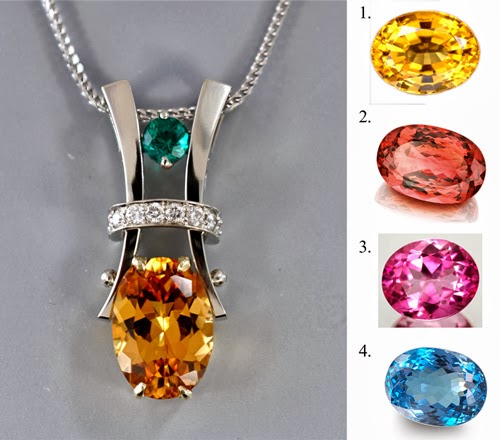
There has been much confusion surrounding the name topaz for many years. The term “topaz” has loosely been used to describe a yellow gem, so at times citrine (see below), which is part of the quartz family, was described as topaz.  Due to this issue, the distinction of precious (Figure #1) and imperial (Figure #2) topaz was made.  Imperial topaz refers to stones with rich golden, deep pink, peach and reddish-orange colors.  The less intense but still beautiful yellow, orange and medium golden hues are referred to as precious topaz.

The term "imperial" stems from the discovery of pink topaz (Figure #3) in Russia during the 19th century.  The stone was instantly so coveted that ownership was restricted to the Czar, his family and those whom he gave it as a gift.  Pink topaz today is the most valuable variety.

Blue topaz (Figure #4) is created through irradiation and is one of the least expensive stones.  While there are natural blue topaz, they are extremely rare; the majority are irradiated.

While there are topaz deposits around the world including Russia, Sri Lanka, the United States, China and Pakistan, the best quality come from Brazil.  The increased worldwide demand for this stone, as well as Brazil’s recent economic boom had caused prices for this stone to more than double.  Prices for imperial topaz has increased 60-70% since 2007.

Given these increases, you may be wondering exactly what these prices are today.  Blue topaz is the least expensive, ranging from $20-40 per carat.  Following this is a large jump to precious topaz, which is around $200-$400 per carat.  The prized imperial topaz goes for $500-$1000 per carat, while the most valuable pink topaz falls in the $1000- $1500 per carat range.  If an imperial topaz is being sold for a very low price, you must be careful as it may have gone through special treatments which are reversible, causing it to lose its color very quickly.  

Citrine is the alternative birthstone of November.  Although it doesn't match the beauty of topaz, it costs much less; around $20- $60 per carat. 

Topaz has a mohs rating of 8, making it a very hard stone.  However, it should still be protected from hard knocks, as it may crack or split due to its perfect basal cleavage, which makes it vulnerable to breakage.

Pictured is a 6.9 carat imperial topaz pendant in white and yellow 18k gold with an emerald and diamonds, designed by Alex Gulko in 2011. 

By Vicky Gulko

Friday, October 4, 2013

Pink Tourmaline is the Alternative Birthstone of October


Tourmaline is the alternative birthstone of October, particularly pink tourmaline.

You can find this incredibly unique stone in almost any color, making it a prized stone in jewelry making throughout history.  The name tourmaline comes from the Sinhalese term "turmali" which means "mixed colors."  Tourmaline ranges from red to green and from blue to yellow, often with two or more colors in one stone called watermelon (Figure #1).  Some tourmalines even change color depending on the light source.

According to Brazilian lore, Tourmalines were brought to earth by extraterrestrial beings of higher intelligence.  This stone has been said to have many healing properties, including cell regeneration when there is a wound or scar tissue; even burns can be cured.  This stone has even been said to make products, such as wrinkle cream or moisturizer more effective if it is left in the preparation.  Rubelite (red variety) tourmalines hold special therapeutic qualities.  They supposedly help increase awareness of your body and free you from impulsive behavior.  Indicolite (blue) is believed to keep off lung diseases.  Yellow tourmaline will serve as an aid when you are sad or depressed,  while polychrome (multi-colored) stones will actually make you more extroverted and sociable.

Tourmaline was the preferred stone of Rene Lalique, master French jewelry designer and one of the finest and most important exponents of the Art Nouveau style in vogue around the turn of the century.

Now let's talk about specifics; different varieties and their prices. Prices of all tourmalines for the last four years have almost doubled due to increased demand from China and production cost in Brazil.

Verdilite (Figure #2):  These are regular green tourmalines that are the most common and range $100-300 per carat.  

Chrome tourmaline (Figure #3): These are a very vivid grass green color and range in price from $400-$700 per carat.  Chrome tourmaline is very similar in color to emerald, and can be used as an alternative to emerald while still achieving a similar look. 

Indicolite tourmaline (Figure #4): This variety is green with a bluish hue, and range from $400-$800 per carat.

There are also pink and red varieties of tourmaline.  

Rubelite tourmaline (Figure #5): This variety has a very hot intense pink color that contain a lot of red.  These are only called rubelite of it continues to display the same intense ruby red color as the light source changes.  Those that change in different light sources are called pink tourmalines.  Pink tourmalines (Figure #6) range from $150-$350 per carat, while rubelite ranges in price from $400-$800 per carat.

Paraiba tourmaline (Figure #7):  This is a very special, unique and extremely rare stone.  It is the most valuable, and comes in a very bright vivid sea blue (see picture).  This fairly new stone was discovered in 1987 in a mine in the village Paraiba, of Brazil.  Paraiba tourmalines from this area have since been depleted and cost anywhere from $20,000-$70,000 per carat making it not only the most valuable tourmaline, but one of the most valuable gems.  There is a new source in Africa, specifically Mozambique, that come in lighter colors and range $3,000-$15,000 in price per carat depending on intensity of color and clarity.  In 2002, Christie's Hong Kong sold a deep pure-blue 8.90 carat Paraiba tourmaline for $30,000 per carat ($270,100 total).  Today, this stone would be worth significantly more.

Tourmaline rates a 7-7.5 on the Mohs scale, making it a very durable stone for everyday wear. 

Today, primary sources for tourmaline are Brazil, various countries in Africa including Mozambique, Namibia, Tanzania, Madagascar and parts of Asia including Russia.

Pictured is a 5.1 carat certified Paraiba tourmaline with diamonds in platinum; designed by Alex Gulko in 2010.

By Viktoriya Gulko

Saturday, September 14, 2013

Opal is the Birthstone of October


Opal is the birthstone of October. 

Opal is an incredibly unique stone that has been named the queen of gems by the ancient Romans because it contains all the colors of the other gems.  The name comes from the Sanskrit term "upala", which means "precious stone."  

Opals have historically been considered a very lucky and powerful stone.   It was said to contain the powers of all the other stones, due to its array of colors.  Opal is a stone of inspiration, it brings deep emotions to the forefront, releasing inhibitions and granting its wearer increased confidence and openness. It also helps to focus mental capabilities and provide motivation and energy.  This has been said to be a very spiritual stone, it wards off the evil eye and brings happy dreams while blocking bad dreams from your psyche.   

In 1872, a new source for opal was discovered in Australia.  These opals were much more beautiful than those discovered before and has since then dominated the world markets, and are what pushed an increasingly high demand for this stone.   The incredible display of colors has been a mystery until relatively recently.   With the use of an electron microscope, studies show that opals consist of transparent spheres of silica that are tightly packed.  The spaces between these silica spheres contain only air and water. In precious opal these spheres are uniform in size and precisely packed into an orderly three dimensional arrangement.   The diffraction of light and iridescence that creates the beautiful look of opal that we know today only occurs if the silica spheres are of the correct size and are precisely arranged.  In lesser quality opal the silica spheres are poorly shaped, of incorrect size, and/or not arranged in a regular pattern.  This stone can form only when an undisturbed space in a rock holds a clean solution of silica from which water is slowly removed over thousands of years.

Opals vary according to transparency and body color.   Prices are very subjective, as no two opals are exactly the same.  

White opal (Figure #1): Translucent stones with color play against a white body color, these are most common. Milky white stones with little color play are used in budget jewelry, while finer quality with higher color play can go for $200 to $300 dollars per carat.

Black opal (Figure #2): Stones with a very vivid play of color and iridescence against a black or dark body color.   These highly prized stones are a fairly new discovery and were unknown before the discovery of the legendary Lightning Ridge opal field in Australia in 1903.  This discovery has caused the demand of this stone to skyrocket.   Today top grade black opal can sell for $15,000 a carat.   Some exceptional stones have even sold for $20,000 a carat. 

Crystal opal (Figure #3): This stone is white and very transparent. It's more valuable than white opal and has a lot of bright colors and iridescence.  The difference between white and crystal opal is white opals have a milky look, where crystal opals are more transparent and have more vibrant color play.  Crystal opal is similar to black opal but is light and more transparent.   In its highest qualities, it is valued at more than $2,500 per carat. 

Fire opal (Figure #4): These stones are transparent or semitransparent, resembling gelatin, with orange, yellow, or red body color with or without play of color.  They are sometimes called Mexican opals because most of the best fire opals are found in volcanic rock in Mexico.  This stone is commonly faceted due to its transparency.  The most prized fire opals are reddish orange, transparent and have play of color within the stone; this quality can retail for as much as $300 per carat.  Lower quality stones that are translucent and yellowish or brownish in color may sell for around $5 per carat. 

Boulder opal (Figure #5): Found in rock formations, specifically ironstone.  The opal often forms in small layers within fractures on the surface of the rock.   Rare gem quality boulder opal can sell for $3,000 to $20,000 per piece, but you can get attractive stones for a few hundred dollars.  

Doublet opal (Figure #6): This is a manmade combination of a small layer of natural crystal opal glued on top of ironstone.  Against the dark surface, it looks like black opal.   Doublet opals are significantly less expensive than black opal, but achieves a similar look.  The main difference is doublets are almost always flat, but black opals are domed and smooth with no facets.  This cut is called cabochon; almost all natural opals are cut this way.  These range in price from $200 to $1,000 per piece.  

Opal has a mohs scale of 7, but you must be careful with this stone due to its chemical structure.  This stone is very sensitive to sudden change in temperature. Never clean your opal in an ultrasonic cleanser as it could crack the opal. It is recommended that your opal be worn frequently, the moisture from the wearers skin helps preserve the stone and prevent it from cracking. 

With its multiple benefits and unique beauty, It is no wonder opals have been prized for centuries. What do you find most interesting about this stone? Which variation of opal strikes you the most? 

Pictured is a 5.6 carat natural black opal from lightning ridge in platinum and diamonds.  Ring was designed by Alex Gulko in 2009. 

By Viktoriya Gulko

Tuesday, August 27, 2013

Sapphire is the birthstone of September

Sapphire is the birthstone of September.

Sapphires are among the most valuable precious gems. The price ranges from a couple hundred to several thousand dollars per carat. They come in all colors of the rainbow, the most valuable being blue, pink and orange, and blue sapphires are the most popular.  The highest quality sapphires are sourced from Sri Lanka; these are called Ceylon sapphires.  Sapphires from Burma are also of high quality but are very rare. Today many come from Madagascar and are generally dark in color.  Some are sourced from Thailand, but have a grey overtone without much brilliance.  This gem is also found in the United States, in the state of Montana but lack a  rich blue color.  Quality is based on color and brilliance.  The closer to a vivid royal blue, with high brilliance, the higher the quality and value.  Some orange sapphires are called padparadscha sapphires, the term is derived from the Sinhalese word for lotus flower.  Padparadscha sapphires are only found in Sri Lanka, and are the rarest of all sapphires.

There has been a recent trend for colored diamonds in engagement rings.  Colored diamonds, such as pink diamonds can come at a very high cost.  Colored sapphires are an excellent substitute.  We have created many engagement rings using colored sapphires to better fit the clients budget.  Sapphires are highly durable stones, they are rated 9 on the Mohs scale, compared to 10 rating of diamond, and 7-8 of other stones, making them ideal for everyday wear.

Ancient folklore claims the sapphire will give its wearer spiritual enlightenment and inner peace.  In the Middle Ages sapphires were used as an antidote to poison and thought to treat colic and rheumatism as well as ease mental illness.  Members of royalty wore sapphires around their necks to protect from envy, poison and harm. 

Sapphires have been used among royalty for centuries.  A very famous sapphire from recent years is princess Diana’s engagement ring which contains a 18 carat blue Ceylon sapphire surrounded by white diamonds in white gold.  This ring is now worn by Kate Middleton.  Other famous icons that have had sapphire engagement rings include Elizabeth Taylor, Joan Crawford and Jean Harlowe.

There are many different treatments being used today on sapphires.  The only accepted form of treatment for fine jewelry is heat treatment.  All other treatments significantly reduce it’s value.  Recently the beryllium treatment is becoming common, especially in stones coming from Asia.  This is when beryllium is added to sapphires to enhance or change the color.  Other treatments include irradiation, where the color of the stone is changed at a molecular level.  Fracture fills are a temporary and unstable method to make cracks and inclusions less noticeable. This treatment can be removed revealing large and unattractive inclusions it has been masking.  Surface dyes are used to change the color of a stone which also can be easily removed.  Often this treatment is used to pass off an impostor gemstone as a sapphire.  These treatments often go undisclosed so it is important to buy sapphires from a reliable source.


Now let's talk about one of the most important factors; the cut.  There is no standard “ideal” cut for sapphires as there are for diamonds.  Each sapphire is cut individually to bring out the best possible color and brilliance.  Due to this individualized cutting, they generally are not graded by gem laboratories.  As a result jewelers set their own standards for quality which they determine based on color and cut.  There are many stones that are cut too deep or too shallow.  A shallow or bad cut can cause a  very common window effect where you can see through the stone.  If a cut is too deep you are paying more for the weight.  Cut is very important for the overall look which is why we only pick perfectly cut stones. 

By Viktoriya Gulko

Saturday, July 27, 2013

The Power of Custom Design "Before and After"

Do you have jewelry that you have inherited or purchased years ago that is outdated or you don’t enjoy wearing?  You can take that jewelry and sell it at a pawn shop for scrap value, or keep the value of the stones and metal and turn it into a beautiful piece of jewelry.  Custom design gives you the opportunity to create something new that fits your style that you will cherish for many years to come. 


One of our clients recently came in with three rings all given by relatives.  The rings were outdated and she didn't enjoy wearing them, but they still held high sentimental value for her.  We were able to combine all the stones from her old rings into a new design that she can enjoy wearing, yet still hold the same sentimental value. 


To celebrate their anniversary, our clients wanted to replace their original engagement ring using their original 0.50 ct marquise diamond.  Our goal was to create a dramatic and substantial looking contemporary ring.  Their concern was that the original diamond not be overpowered by a bolder setting.  The solution was to create a design using pave-set round diamonds under the marquise to achieve the illusion of a larger diamond and balancing out the ring.


A client came in with a precious imperial topaz that she has gotten reset twice, but was never satisfied with the results.  She had always dreamed about having a hand crafted antique style ring, so we designed a unique Victorian style ring for her to showcase her stone.  The stone was not perfectly cut and had a window effect.  We were able to mask this window effect through the use of the setting.  She not only was able to get the antique ring she had always wanted, but was also able to finally enjoy her stones in a design she loved.

Friday, July 19, 2013

Peridot is the Birthstone of August


Peridot is the birthstone of August.

While the exact origin of the name peridot is unknown, many sources state it comes from the Arabic word farodat, meaning gem.  Peridot is one of the few gems that come in one distinctive color.  The most valuable is an intense deep green color.  Peridot is known to make the wearer look younger and more beautiful. 

Peridot was one of Cleopatra's favorite stones.  While many believe Cleopatra's favorite stone was emerald, there is an abundance of archeological evidence that points to what was thought to be emeralds were actually peridot.  Ancient Egyptians called them "gem of the sun" because of its high brilliance under the sun.

Peridot was considered more beautiful than emerald.  It is widely believed that this stone was so beautiful, it was used as the second stone in the high priest's breastplate for the second temple of Jerusalem built in 515 BC, with ruby being the first.

This gemstone was said to glow at night. Ancient minors would search in the evening or night when they said it was easiest to find.  Romans called peridot "evening emerald" because they stayed vibrant and bright under all lighting conditions and did not darken under night sky.

Some have the perception that peridot is not a good stone because they haven't seen it in beautiful quality.  As soon as our clients discover the peridot we carry, they fall in love with the stone forever.

While almost all gemstones are formed in the earth’s crust, peridot is formed much deeper, in the mantle. The only other stone formed in the mantle is diamond.  Peridot is sourced from many places such as China, Burma, and Arizona, but the best come from Pakistan. Although peridot from Pakistan is becoming increasingly rare, we only source ours from this region.

The stone is very transparent, so picking a very clean stone is important as inclusions are more visible than in other stones.
Peridot is a relatively inexpensive stone, for a fine quality stone sized between 3-10 carats you would typically pay $200-500 per carat.  Though finest quality stones from Pakistan over 6 carats are rare.

The pendant pictured is a 13 carat Pakistani peridot in 18k gold with diamonds.  The earrings each contain a 4 carat  Pakistani peridot in 14k gold.

By Viktoriya Gulko